Taking Quantum Chemistry onto Real Hardware
Our first chemistry workflow ran on a hosted Qristal CPU simulator. We have now carried its representative circuits onto real quantum hardware through Marqov: nine tasks and 1,400 shots on IQM Garnet, accessed through Amazon Braket, with returned counts connected to the same restricted-space energy calculation.
The execution path worked. The initial low-shot estimates missed our accuracy targets. A separate calibration pilot then showed why a successful submission and a defensible scientific result are different milestones.
This continues our independent adaptation inspired by the Quantum Brilliance and Oak Ridge preprint. We use our own unembedded four-helium restricted matrices. These runs do not reproduce the paper’s embedded chemistry, diamond processors or parallel performance experiment.
A workflow that reaches the device
The first screen contained four computational-basis probes, followed by one monomer and one dimer circuit. Marqov admitted the saved OpenQASM circuits, returned the provider results, and connected those counts to classical evaluation. Each submission retained its original identity; observation failures did not create replacement jobs.
We correlated the circuit source, submitted action, device, shot count, measurement labels and raw counts against retained provider captures. The asymmetric two-qubit basis probes qualified the tested register convention before chemistry evaluation.
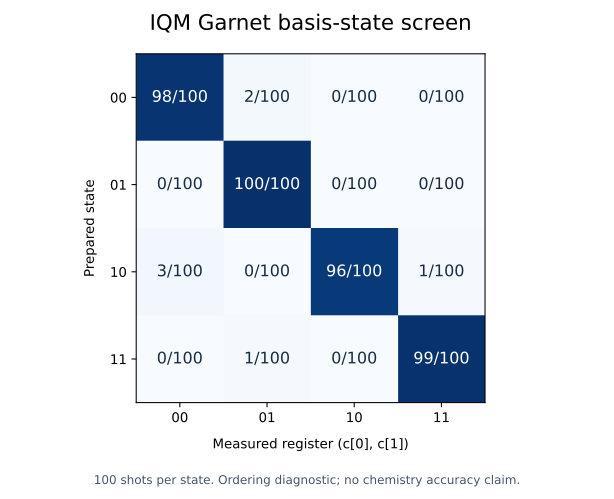
The probe gate checks the tested count and register convention. It does not certify chemistry accuracy, circuit fidelity or transferable readout calibration.
The chemistry circuits each used 200 shots. One monomer distribution is reused across four monomer matrices, and one dimer distribution across six dimer matrices. That is two measured chemistry circuits, not ten independent hardware fragment experiments.
What the energies told us
The first assembled estimate had an absolute error of 0.272964 Hartree against our exact restricted-matrix reference. Every fragment missed its 0.0001-Hartree target, and the assembled result missed the 0.0014-Hartree benchmark. The subtractive fragment assembly is not variational, so an assembled energy below this reference does not imply a ground-state bound violation.
We then ran a separate one-qubit calibration pilot: prepare zero, prepare one, and sample a fresh monomer circuit, each at 200 shots.
| Circuit | Zero counts | One counts |
|---|---|---|
| Prepare zero | 198 | 2 |
| Prepare one | 6 | 194 |
| Fresh monomer | 198 | 2 |
The measured monomer’s one-state frequency equalled the zero-preparation false-positive frequency. Under an assumed common stationary preparation-and-measurement channel, the constrained correction therefore reached the boundary probability of zero for that state.
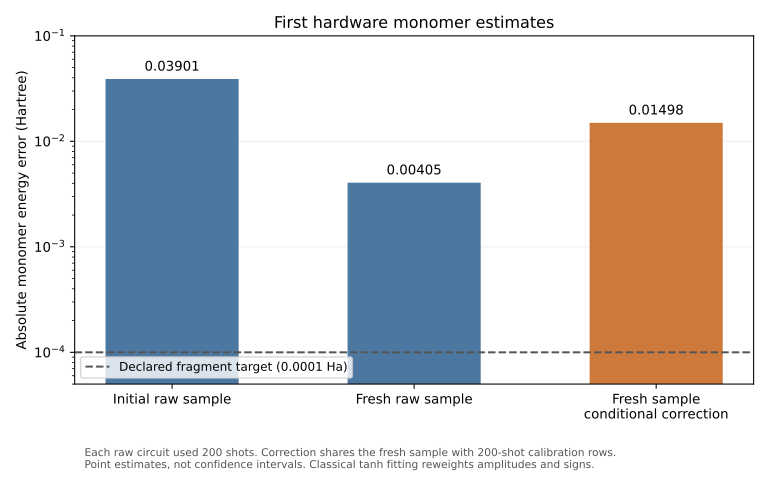
The fresh raw monomer error was 0.00405483 Hartree. The conditional correction worsened it to 0.01498009 Hartree. Both missed the fragment target. These are individual retained estimates, not confidence intervals or a controlled improvement comparison between the two raw samples.
The ideal monomer circuit places about 0.00432 probability on the rare state: fewer than one expected count in 200 shots. The pilot shows a sampling and calibration problem worth measuring at a larger budget. It does not establish the cause of hardware error or guarantee that more shots will achieve accuracy.
The qubits behind the register labels
The retained IQM compilation results revealed another calibration constraint. The same virtual registers did not always reach the same physical qubits:
| Captured circuit | Physical qubits in register order |
|---|---|
| Initial zero-zero probe | 2, 4 |
| Initial zero-one probe | 2, 10 |
| Initial one-zero probe | 10, 2 |
| Initial one-one probe | 2, 10 |
| Dimer | 16, 17 |
| Dedicated zero/one calibration and fresh monomer | 1 for each task |
The two-qubit probe rows therefore do not form one matched physical calibration channel for the dimer. Their logical register checks still apply; transferring their readout matrix to the dimer would require an assumption the captured mappings do not establish.
The separate one-qubit pilot passes the captured physical-mapping check. That is necessary for correction, but does not prove matching calibration epochs, channel stability or preparation fidelity. Future runs must check the compiled assignments again before interpreting corrected energies.
The compiled-mapping evidence, replay script and instructions let readers inspect these assignments without private task or account identifiers. This replay checks supplied text and hashes; it does not authenticate provider origin.
Making the result inspectable
The public Marqov report brings the hosted baseline, hardware counts, calibration pilot and physical mapping checks together in one read-only checkpoint. No account is required. The historical research notebook and private operational captures remain separate.
Independent replay reproduced the matrix references and reported point estimates. Our energy estimator includes classical tanh refitting, which changes amplitude magnitudes as well as signs. The reported energies assess the combined measured-count and classical-fit estimator; they are not direct hardware energy measurements.
Conditional bootstrap diagnostics omit drift, circuit error and calibration mismatch. They cannot establish hardware confidence coverage, and sparse or absent outcomes remain a limitation. Even matching captured physical assignments does not prove a stationary calibration channel.
The six-circuit evidence bundle and calibration evidence bundle contain public matrices, counts and numerical results. Each directory also provides a replay script for the first screen or the calibration pilot, plus the supporting first-screen numerics and instructions, or calibration numerics and instructions. Save each bundle’s four files together, install NumPy and SciPy, and run python replay.py evidence.json.
These public replays check point-estimate consistency. They do not authenticate the private provider captures, reproduce bootstrap coverage or certify hardware accuracy.
The next experiment
The next step is a larger, predeclared calibration and chemistry sampling budget, retaining all outcomes. We will then extend the workflow to actual adaptive fragment execution and a second compatible provider, measuring useful work, overhead and phase-end tails. Cross-provider performance and cancellation benefits remain to be demonstrated.
Our first hardware checkpoint establishes a working Marqov submission, count collection and numerical replay path. The scientific checks made the limitations visible and changed the next experiment.
Want to run a workflow with your team? Sign up for Marqov and mention the chemistry demonstration. Researchers interested in calibration, embedded inputs or hardware collaboration can contact us.
This independent work does not imply participation or endorsement by Quantum Brilliance, Oak Ridge, IQM or Amazon.