Quantum Chemistry Needs More Than Qubits
Building on a new paper from Quantum Brilliance and Oak Ridge to explore the role of open source orchestration tools in multi-QPU execution.
Quantum processors do not produce a chemistry result on their own. Sampling must connect to classical energy evaluation, convergence decisions, fragment scheduling, and the assembly of a final answer. A recent Quantum Brilliance and Oak Ridge National Laboratory preprint makes that coordination problem concrete: three diamond-based quantum processors cooperate on fragment molecular orbital calculations, improving sampling throughput while preserving accuracy.
This paper arrived at a useful moment. We have been developing Marqov’s research agent and hosted execution tools, including support for Quantum Brilliance’s Qristal simulator. Could an agent use that workflow to turn a newly published quantum chemistry method into an auditable experiment—and eventually carry it onto commercial quantum hardware?
I previously worked at Quantum Brilliance and am involved in Oak Ridge’s openQSE efforts, so this is a topic I care about personally. We started with a hosted simulation baseline. The work required human guidance and engineering, but it produced a running, independently checked experiment and a concrete path toward hardware execution.
To do so will take a few phases, so this post shows how the first phase was achieved by building and executing a first adaptation on Marqov using Qristal CPU simulation. The result is a reproducible hosted baseline for the next step: automating the same class of workflow on real quantum hardware and, subsequently, across providers.
Phase 1: a working hosted baseline
Our experiment uses an independently generated four-atom helium model. Four monomer and six dimer problems are represented in small restricted configuration spaces, and their energies are combined using the two-body fragment assembly formula.
We executed three configurations as actual managed Marqov jobs:
- Serial: a reference execution of the sampling and classical evaluation stages.
- Synchronous pooling: multiple sampling tasks contribute raw counts to a combined distribution before fragment energies are evaluated.
- Adaptive fragments: a coordinator tracks which fragments have met the declared accuracy target, freezes their accepted results, accounts for late-arriving samples, and advances from monomers to dimers after the phase drains.
The workflow connects five stages:
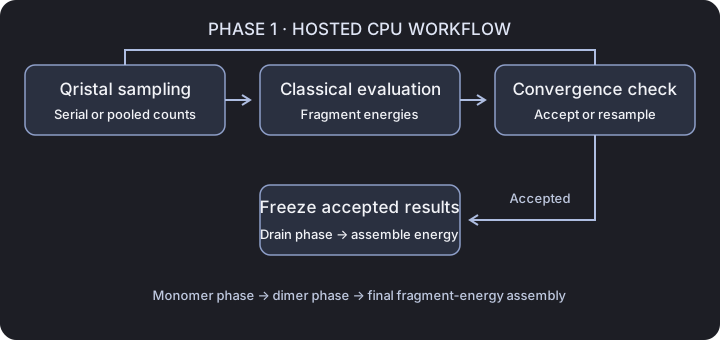
The adaptive run completed three actual jobs. Its first accepted fragment energies remained fixed; a later monomer result was retained as a sampling tail rather than silently replacing those energies. This makes both the scientific selection rule and the work performed inspectable.
Results
Our classical reference energy is −11.340870484155 Hartree, obtained by exact diagonalization of each restricted fragment Hamiltonian and the same two-body assembly used for the sampled results. The geometry is a four-helium square with 3 Å sides, using RHF orbitals and the cc-pVDZ basis. This is our independently generated, unembedded reference, not the paper’s embedded He4 reference.
All three configurations met the declared assembled-energy tolerance of 0.0014 Hartree against the restricted-space classical reference. All ten fragments met the 0.0001 Hartree fragment tolerance.
| Configuration | Actual total shots | Assembled energy (Hartree) | Absolute error (Hartree) |
|---|---|---|---|
| Serial | 600,000,000 | −11.340827959220 | 0.000042525 |
| Synchronous pooling | 600,000,000 | −11.340827747667 | 0.000042736 |
| Adaptive fragments | 99,999 | −11.341000349519 | 0.000129865 |
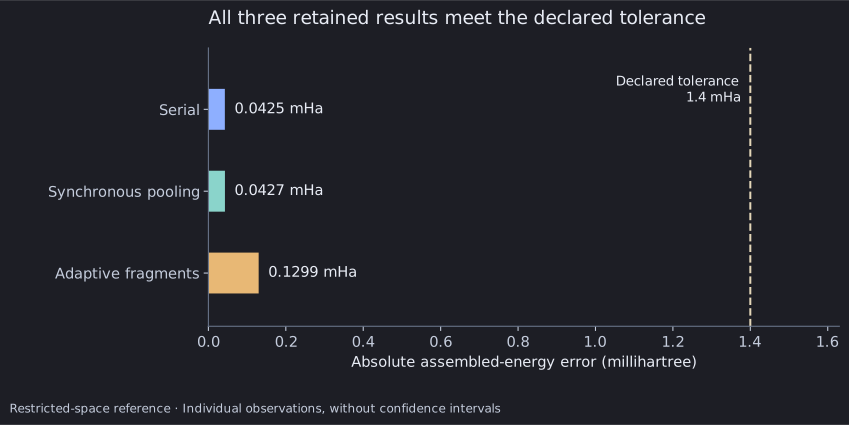
Each bar is one retained assembled result against our restricted-space reference. The chart compares observed accuracy, not sampling efficiency.
Why the sampling budgets differ
The static runs used a fixed budget of 300 million shots for the monomer circuit and 300 million for the dimer circuit. Serial execution sampled that budget on one sampler per phase; pooling divided each phase’s budget equally among three samplers, at 100 million shots each. The counts were collected in real Qristal calls of up to 10 million shots, with distinct seeds, then combined. A sampled distribution can be reused to evaluate several fragment Hamiltonians, so these totals count circuit samples rather than shots multiplied by the number of fragments.
The adaptive workflow instead used 33,333 shots per submitted round, checking the remaining fragments after each result. One monomer result accepted all four monomers; one dimer result accepted all six dimers. A second monomer job also ran, but its result arrived after the accepted monomer results were frozen. These are different experimental budgets and stopping policies, not a matched-budget benchmark.
The adaptive total includes 33,333 late-tail shots. These are actual consumed samples, not additional useful convergence work. Its smaller sampling budget is not a controlled efficiency comparison with the two static runs.
This phase demonstrates correct execution and numerical processing; it does not demonstrate a speedup. Admission-to-completion elapsed time was approximately 939 seconds for serial and 1,230 seconds for synchronous pooling. These end-to-end measurements include orchestration overhead. We observed overlapping task containers, but did not establish a cross-host sampling clock bound or simultaneous adaptive sampling.
What the error does—and does not—measure
The absolute error is the difference between the sampled assembled energy and the exact reference for this restricted model. It is not an uncertainty estimate for real helium chemistry: it excludes missing configuration space, embedding effects and hardware noise. These are individual retained workflow outcomes, not repeated independent trials with confidence intervals. Finite sampling and sign-model fitting affect the estimates, while adaptive acceptance uses the known reference as a stopping criterion. We therefore report no statistical error bars or general success probability.
What happened in the adaptive workflow
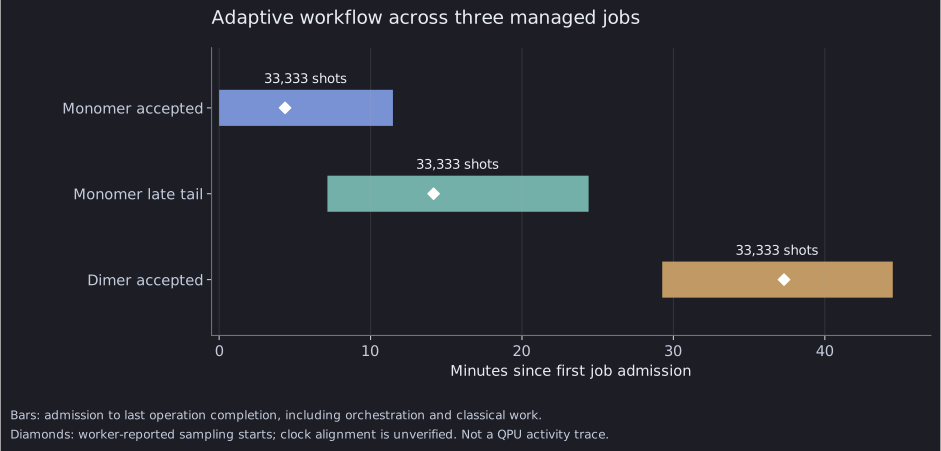
Bars run from recorded job admission to the last recorded operation completion. They include compilation, scheduling, classical evaluation and result assembly. Diamonds mark worker-reported sampling-call starts; the calls themselves lasted about 0.07–0.09 seconds and are too short to show at this scale. Cross-host clock alignment was not verified, so this is a managed-job timeline, not evidence of simultaneous sampling or hardware utilization.
The second monomer job was admitted before the first job completed. Its later result contributed no newly accepted fragments, and the coordinator retained it as a late tail. The dimer job was admitted after both monomer jobs had completed. A further dimer job was prepared but never submitted, so it consumed no sampling shots. The observed gaps include operator and platform coordination; this was not a continuously automated scheduling benchmark. No running-job cancellation was demonstrated.
Checking the answer independently
We checked more than agreement between two implementations of the same formula.
An independent fermionic-operator calculation reconstructed every entry of all ten fragment Hamiltonians directly from retained molecular integrals. The maximum matrix discrepancy was 2.44 × 10⁻¹⁵ Hartree. Separate auditors reconstructed normalized coefficient energies from raw counts and fitted sign weights, then checked the fragment-energy assembly.
We also downloaded the retained source, inputs, observations, and audit artifacts from the original Marqov project into a clean directory. That replay reproduced the chemistry matrices and the reported serial, pooled, and adaptive energies. The adaptive replay verified its three-job ledger, sampling totals, late tail, and frozen acceptance rule.
Source and input hashes, scientific exports, and execution provenance are retained with the experiment. This makes the result a traceable execution record rather than a screenshot of a successful calculation.
For public inspection, download the numerical evidence appendix and the Python replay script. Save both in the same directory, install NumPy, and run python replay.py. The appendix includes the restricted Hamiltonians, observed counts, fitted sign weights, first-accepted fragment results, sampling totals and timeline coordinates. The replay recomputes the three assembled energies from counts and weights. It checks numerical consistency; it does not independently verify cloud execution provenance or regenerate the molecular integrals. The internal project notebook remains separate from this curated public evidence.
What this establishes—and what comes next
This is an independent, unembedded He4 adaptation on a noiseless Qristal qpp CPU backend. It is not a reproduction of the authors’ full electrostatically embedded FMO calculation, diamond quantum hardware, device-specific calibration, or measured parallel efficiencies. Our coordinator freezes the first accepted fragment result; the paper describes assembly from the lowest obtained fragment energies. That difference is explicit rather than treated as method equivalence.
The contribution of Phase 1 is a hosted and independently audited starting point: sampling, classical evaluation, adaptive state, and retained evidence connected in Marqov.
Our next milestones extend that starting point:
- Phase 2 — Automated hardware execution. Run representative monomer and dimer circuits on a compatible gate-based QPU, connect returned counts to the same classical checks, and retain device-specific calibration and provider receipts.
- Phase 3 — Cross-provider orchestration. Execute across heterogeneous providers, qualify circuit and measurement conventions, and compare equal with measured-rate-aware sampling allocation.
- Phase 4 — Measured orchestration performance. Compare useful throughput, scheduling overhead, and unnecessary work at phase boundaries. Test cancellation only where the provider supports it, distinguishing queued cancellation from interruption of running execution.
The original paper identifies non-interruptible executions as a source of wasted phase-end time. That is a concrete question for the next experiments, not a performance improvement we claim to have delivered already.
Follow the next experiment
We are targeting a Phase 2 update during the week of October 12, 2026, focused on representative monomer and dimer execution on a compatible gate-based QPU. That is our next experimental milestone, not a hardware result already achieved; the update will report what we ran, what passed and any remaining limitations.
Want to explore these workflows with your own team? Request access to Marqov and mention the Qristal chemistry demonstration in your request. Researchers interested in embedded inputs, device calibration or a hardware collaboration can also contact us directly. The article, charts and numerical appendix are publicly accessible without a platform account.
This work was independently performed by Marqov and was inspired by the cited preprint. It does not imply participation or endorsement by Quantum Brilliance or Oak Ridge National Laboratory.